


Sleep is a physiological need and, therefore, sleep deprivation and/or restriction causes various health problems, such as a greater propensity to cardiovascular and metabolic diseases, a general reduction in the immune system, hormonal imbalances and the development of mental illnesses such as depression and anxiety (TASKAR; HIRSHKOWITZ, 2003). However, a large proportion of the population does not achieve adequate total sleep time and/or satisfactory sleep quality (BUYSSE; ANCOLI-ISRAEL; EDINGER; LICHSTEIN et al., 2006) and this scenario is no different in Brazil. Studies indicate that the presence of sleep complaints such as snoring, nightmares, bruxism, kicking the legs while sleeping, sleepwalking and daytime sleepiness increase significantly every decade (SANTOS-SILVA; BITTENCOURT; PIRES; DE MELLO et al., 2010). In addition, polysomnography has shown that obstructive sleep apnea syndrome affects around 32.8% of the population (TUFIK; SANTOS-SILVA; TADDEI; BITTENCOURT, 2010). Similarly, 32% of the population suffers from insomnia (CASTRO; POYARES; LEGER; BITTENCOURT et al., 2013). Considering these data, it is important that the population’s sleep is assessed with the aim of improving general health and quality of life.
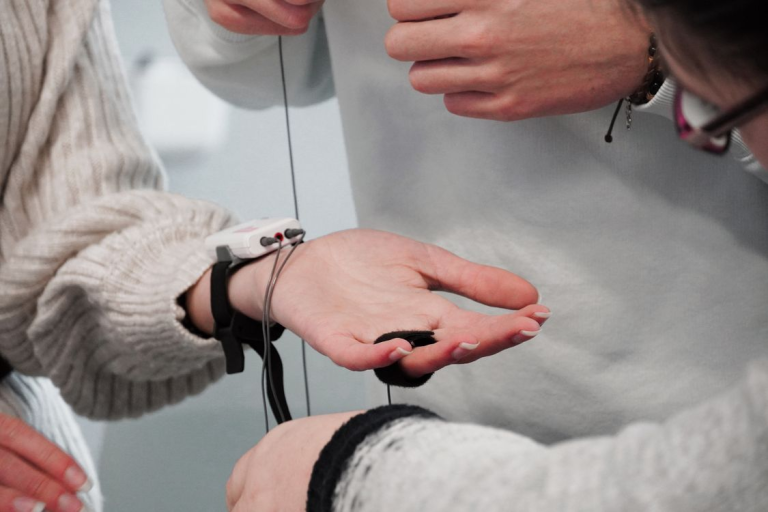
In this respect, sleep can be assessed using polysomnography, which consists of an electroencephalogram, electrooculogram, chin and leg electromyogram, electrocardiogram, nasal cannula, abdominal belt, oximeter and snoring sensor. With this, it is possible to objectively determine the percentage of time the patient spends in each sleep stage, as well as determine the presence of sleep disorders such as obstructive apnea, central apnea, periodic leg movement, bruxism, among others. For this reason, polysomnography is the gold standard for identifying sleep patterns and the presence of sleep disorders (CHESSON; FERBER; FRY; GRIGG-DAMBERGER et al., 1997). To carry out this test, there is the option of the patient traveling to the sleep clinic and sleeping there, and during the sleep period, trained professionals stay in a parallel room reading the patient’s data in real time. Despite being considered the gold standard, polysomnography has the disadvantages of interfering with the participant’s sleep routine and being expensive.

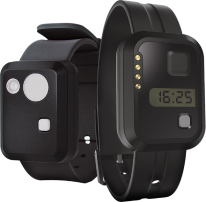
Actigraphy or actimetry is a technique that can also be used for sleep analysis. The actigraph is a device similar to a wristwatch and contains an accelerometer, a light sensor and some models contain temperature sensors. With this, it is possible to non-invasively estimate the patient’s sleep periods (SADEH, 2011). The great advantage of the actigraph is the comfort and practicality provided by its use and, for this reason, examinations can be longer, but generally the time used varies between 7 and 28 days. Thus, actigraphy is also an effective technique for determining the patient’s biological rhythm. Similarly to polysomnography, a disadvantage of this technique is its relatively high cost and the difficulty of analyzing a high volume of people at the same time due to the need to own the equipment.
Finally, sleep can be analyzed using questionnaires and sleep diaries. Questionnaires have the convenience of being completed only once, and ask questions relating to conventional sleep. On the other hand, sleep diaries are instruments that have to be answered daily and, for this reason, tend to present more reliable estimates than questionnaires. The purpose of a sleep diary is to record sleep habits, as well as bedtimes, wake times and activities carried out during the day. The main advantage of the sleep diary is its low cost and the possibility of assessing several people at the same time.
Not only that, the sleep diary is strongly recommended for diagnosing insomnia. The American Psychiatric Association characterizes insomnia as a subjective disorder, i.e. the diagnosis is made based on the patient’s report of sleep-related difficulties, or waking up without feeling fully recovered. In addition, evaluation with polysomnography can lead to a worsening of sleep quality due to the visit to the laboratory (EDINGER; FINS; SULLIVAN JR; MARSH et al., 1997). Similarly, actigraphy is also not an effective technique for diagnosing insomnia, as patients with this disorder tend to lie still for a long time trying to initiate sleep, which can lead to misinterpretation of the data (CHAMBERS, 1994). The insomnia severity questionnaire is an effective tool for analyzing the degree of insomnia severity, but it lacks important information for sleep analysis, such as total sleep time, sleep onset latency, number of awakenings and time awake during the night (MORIN, 1993). For these reasons, the sleep diary is considered the gold standard for subjective sleep analysis.
Thus, various sleep diary models have emerged over the years, making it difficult to interpret the data correctly, which in turn leads to difficulties in translating scientific findings into clinical practice. To solve this problem, a committee was set up to propose a standardized sleep diary (CARNEY; BUYSSE; ANCOLI-ISRAEL; EDINGER et al., 2012). The conference was attended by several sleep and insomnia specialists. All the experts involved agreed that the model would be built specifically for patients with complaints of insomnia, but that it would also be suitable for use with patients with other sleep disorders, as well as for evaluating the sleep of good sleepers. Thus, three models were built. One model refers to the core of the sleep diary, and contains questions that are considered to be essential. The other templates contain additional questions related to daily activities.
The sleep diary template
The core of the template contains the following questions: (a) What time did you go to bed?; (b) What time did you try to go to sleep?; (c) How long did it take you to fall asleep?; (d) How many times did you wake up during your sleep?; (e) In total, how long did these awakenings last?; (f) What time did you get out of bed today?; (g) How would you rate the quality of your sleep? (Likert scale with the options: very bad, bad, moderate, good and very good); (h) Additional comments. This template should be answered within one hour of waking up and, if this instruction is not followed, that day should not be filled in.
The other two templates have the following instructions: the morning template should be filled out in full upon waking up, while the evening template should have the shared questions answered upon waking up, and the questions related to day-to-day activities should be answered before going to bed. The questions included in these templates are:
Shared issues(a) At what time did you go to bed?; (b) At what time did you try to start falling asleep?; (c) How long did it take you to fall asleep?; (d) How many times did you wake up during the night, not considering your final awakening?; (e) In total, how long did these awakenings last?(f) What time was your last awakening? (g) After your last awakening, how long did you stay in bed trying to fall asleep again? (h) Did you wake up earlier than planned? (i) If so, how much earlier?(j) What time did you get out of bed today?; (k) In total, how long did you sleep?; (l) How would you rate the quality of your sleep? (Likert scale with the options: very bad, bad, moderate, good and very good); (m) How rested or recovered did you feel when you woke up today? (Likert scale with the options: not at all rested, not very rested, rested, well rested, very well rested); (n) How many times did you nap?; (o) In total, how long did your naps last?
Extra questions(a) How many servings of alcoholic beverages have you consumed?; (b) At what time did you consume the last serving?; (c) How many servings of caffeinated beverages (coffee, tea, soda or energy drink) have you consumed?; (d) At what time did you consume the last serving?; (e) Have you consumed any medication prescribed or taken on your own to help you sleep? If yes, list the medication(s), dosage and time of intake; (f) Comments (if applicable).
In other words, in the morning model, both the shared questions and the extra questions must be answered within an hour of waking up. In the evening model, the shared questions must be answered within an hour of waking up and the extra questions must be answered before going to bed.
How many days should the sleep diary be filled in for?
The sleep diary should be used for a sufficient period of time so that the data obtained is not misinterpreted and interferes with the analysis carried out. It is important to stress that each objective will require a different analysis. Therefore, there is still no consensus on how long the sleep diary should be used. Some authors have used the sleep diary for less than a week (KAWADA, 2008), while other authors used it for 7 days or more (MONK; BUYSSE; KENNEDY; POTTS et al., 2003; SHORT; GRADISAR; LACK; WRIGHT et al., 2012).
In order to identify the appropriate time of use for adolescents, a study was carried out with participants from different locations and cultures (Australia, Qatar, the United Kingdom and the United States)(SHORT; ARORA; GRADISAR; TAHERI et al., 2017). The results show that the minimum registration time seems to be 5 nights, but this result depends on the country of origin. Furthermore, the study did not include participants from Brazil or Latin America.
Similarly, another study evaluated university students with the aim of identifying the appropriate time to use a sleep diary (DE ALCANTARA BORBA; REIS; DE MELO LIMA; FACUNDO et al., 2020). To do this, the participants filled in the sleep diary for 28 days. As expected, the results suggest that the longer the sleep diary is used, the more reliable the data obtained. However, it is possible to use it for just 7 days if desired.
Electronic sleep diary and printed sleep diary: which is better?
With the advent of technology, it is possible to have access to filling in the sleep diary from the palm of your hand on a smartphone or tablet. Thus, the electronic sleep diary has a number of advantages, such as: (a) self-monitoring of sleep, allowing patients the opportunity to share decision-making with doctors; (b) increasing the likelihood of filling in the sleep diary through automatic reminders; (c) preventing patients from filling it in retrospectively; (d) reducing the time it takes to obtain and analyze data (GARTENBERG; THORNTON; MASOOD; PFANNENSTIEL et al., 2013; STONE; SHIFFMAN; SCHWARTZ; BRODERICK et al., 2002).
In order to analyze the difference between the data obtained through the electronic and printed sleep diaries, 15 healthy adult volunteers underwent a study (TONETTI; MINGOZZI; NATALE, 2016). The results suggest that there is no difference between the data recorded in the electronic sleep diary and the printed sleep diary. Therefore, considering the advantages of the electronic sleep diary, it seems to be superior to the printed sleep diary. However, a limitation of the study was the use of healthy adults, which prevents the generalization of the results to populations with sleep disorders or patients in other age groups.
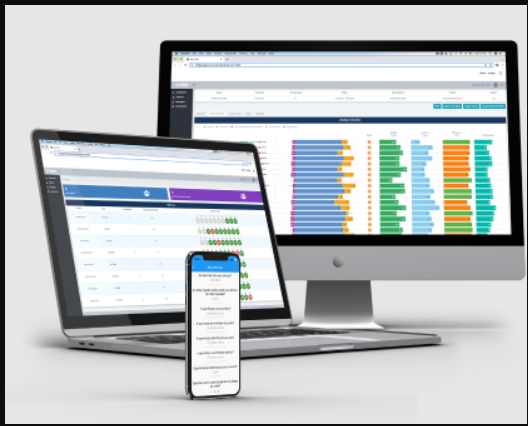
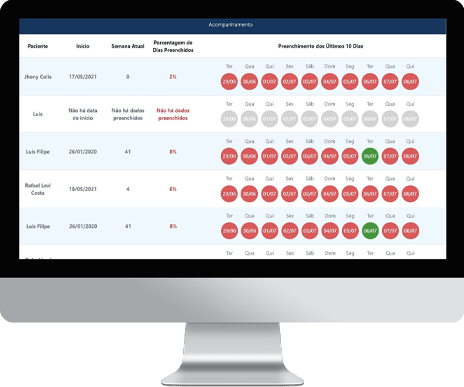
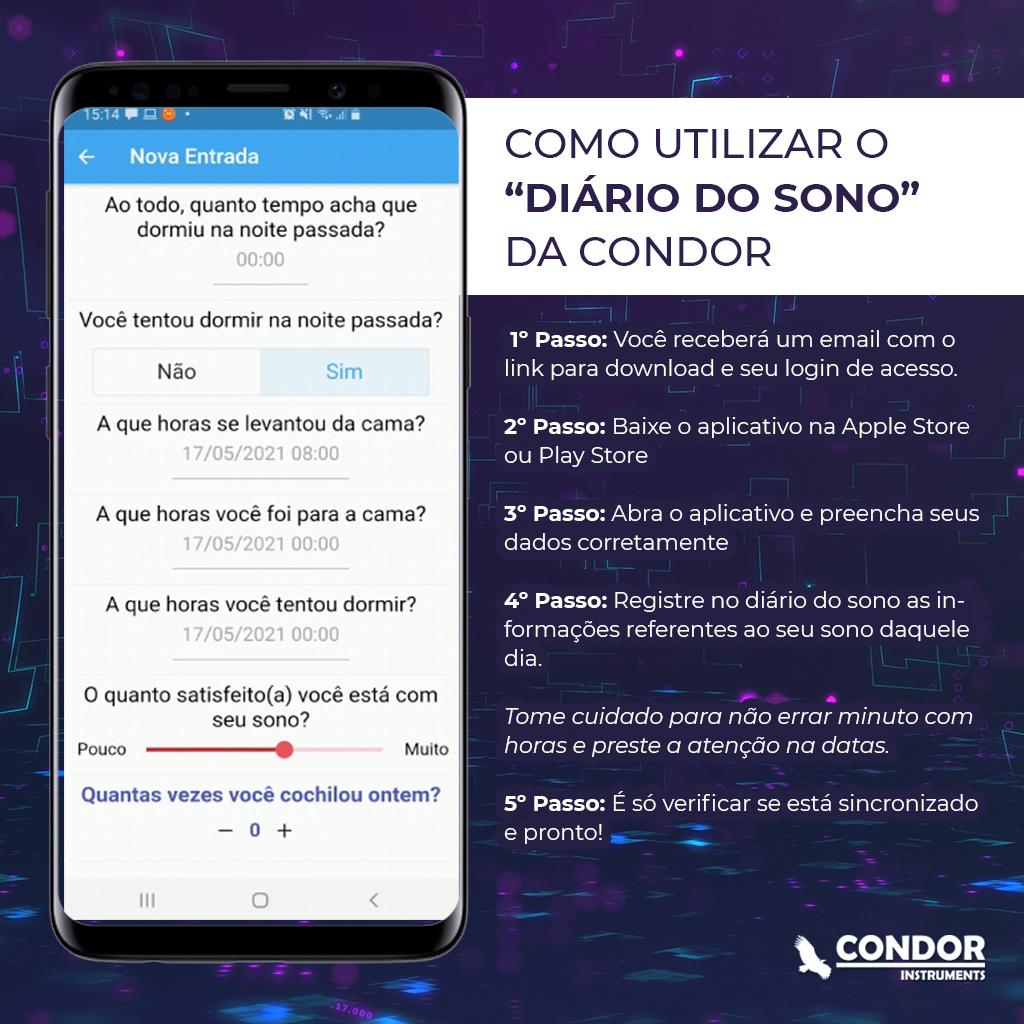
In order to facilitate the process of filling in and analyzing data, Condor offers an app that allows patients to fill in their sleep diaries on their personal cell phones. The benefits of using the app are the convenience offered to the patient, the impossibility of backfilling, automatic analysis of sleep-related variables, real-time monitoring and the generation of automatic graphs that help visualize the results.
Final considerations
The sleep diary is an effective tool for identifying the sleep patterns of both good sleepers and patients with sleep disorders. In addition, because it is inexpensive and easy to use, it allows a large number of people to be assessed at the same time. It is particularly suitable for diagnosing insomnia, since polysomnography and actigraphy are not specific to this disorder. Not only that, but the use of a sleep diary in digital format is more advantageous than one printed on paper.