


Actiwatch Migration Guide
Replacing the Philips Actiwatch without losing your data — or your light measurements
Philips discontinued the Actiwatch. Most replacement guides compare wear time and price. This one compares the two things that actually protect your research: data continuity and light measurement capability — with verified specifications and peer-reviewed sources.
The two questions that should drive your choice
When a device family is discontinued, research groups face two distinct risks. The first is losing comparability: years of Actiwatch recordings, scored with the Actiware algorithm, that new hardware cannot reproduce. The second is losing capability: the Actiwatch Spectrum measured light in multiple spectral channels, and most of its likely successors measure just one.
Every replacement candidate should be interrogated on both fronts: Can it keep my old data usable and my scoring consistent? And can it measure light at least as well as what I had?
Data continuity: the question to ask every vendor
Activity counts are device-specific. No actigraph reproduces another manufacturer’s proprietary counts from raw acceleration — which is why switching hardware normally splits your dataset into a “before” and an “after” that reviewers will question.
We built ActStudio, the analysis software for ActTrust and ActLumus, to make this transition explicit rather than painful. Three capabilities matter here:
- Actiwatch file conversion. ActStudio includes a file converter between the Actiwatch data format and the Condor format. Your archive of Actiwatch recordings remains usable — you can open, inspect and reprocess legacy files alongside new data instead of leaving them stranded in an unsupported ecosystem.
- Actiwatch-style sleep scoring, maintained. ActStudio implements the sleep-scoring algorithm as described in the Philips Actiware documentation, and its output has been validated against Actiware scoring — alongside Cole-Kripke, PIM, ZCM and TAT. You can keep scoring new recordings with the method your published protocols already cite, and verify on your own recordings that it reproduces your historical outputs (step 1 of the protocol below).
- Export in Actiware-style CSV. Data collected with ActLumus or ActTrust can be exported as CSV files matching the layout of the CSV that Actiware exports. Analysis scripts and pipelines built to consume Actiware CSV output keep working unchanged.
You don’t have to choose between abandoning your Actiwatch archive and freezing your lab in discontinued hardware. Convert the old files, keep the scoring algorithm, export in the format your pipeline already speaks.
Data continuity, though, is only half of the decision — and it is worth evaluating every replacement candidate on it. The question that separates the candidates far more sharply, and the reason we built ActLumus the way we did, is the second one: light.
Migration facts — ActStudio (Condor Instruments)
- Converts files between the Actiwatch format and the Condor format (both directions of your workflow: legacy files in, compatible exports out)
- Implements the Actiware sleep-scoring algorithm as described in the Philips Actiware documentation, output validated against Actiware scoring — plus Cole-Kripke, PIM, ZCM, TAT, cosinor and non-parametric circadian variables (IS, IV, RA, L5, M10)
- Exports ActLumus / ActTrust recordings as CSV in the same layout Actiware exports — existing CSV-based pipelines keep working
- Raw data export for R, Python and MATLAB for fully reproducible analyses
Light measurement: where most replacements silently downgrade
The Actiwatch Spectrum recorded light in multiple spectral channels (red, green, blue). Since CIE S 026:2018, circadian research is expected to report melanopic equivalent daylight illuminance (melanopic EDI) — a quantity that requires spectral information a single broadband channel cannot provide.[6]
This is where replacement paths diverge sharply. Verified against each manufacturer’s own documentation:
| Specification | Actiwatch Spectrum discontinued[3] | Condor ActLumus | Activinsights GENEActiv | CamNtech MotionWatch 8 | ActiGraph wGT3X-BT |
|---|---|---|---|---|---|
| Spectral light channels | Multi-channel (R/G/B) | 10 channels | 1 channel (peak 560 nm)[1] | 1 channel (photopic)[7] | 1 channel |
| Melanopic EDI (CIE S 026) | Not reported | Yes — derived from 10 channels[2] | No | No | No |
| Stated illuminance range (manufacturer) | Up to ~20,000 lux | 1 – 100,000 lux[2] | 0 – 50,000 lux (v1.3)[1] | 0 – 64,000 lux[7] | Not published |
| Measured detection range (NIH benchmark)[4] | Not tested | 2 – 100,000 lux | 2 – 40,000 lux | Not tested | 50 – 20,000 lux |
| Measured accuracy vs criterion (NIH benchmark)[4] | Not tested | +3.3 ± 13.4% | Below −20% | Not tested | Below −20% |
| Battery at 60 s epoch | ~30 days | 2 months | Up to 30 days | 91 days[7] | Not published |
“Stated” rows are self-reported manufacturer figures: GENEActiv from the Activinsights Instructions for Use, Rev. 010; ActLumus from the Condor Instruments manual and datasheet (which also states 2% irradiance accuracy at 10 µW/cm²); Actiwatch Spectrum from legacy Philips/Respironics documentation; MotionWatch 8 from CamNtech’s product page. “Measured” rows are independent NIH benchmark results (Ishihara et al. 2026), same criterion spectrometer, same bench, same units. Where a manufacturer does not publish a figure it is marked “not published” rather than estimated; devices not included in the NIH study are marked “not tested”. Captured August 2026.
What the NIH benchmark found
In 2026, researchers at the National Institute of Diabetes and Digestive and Kidney Diseases (NIH) published the most rigorous independent evaluation of wearable light sensors to date.[4] They tested eight units from each of four manufacturers — 32 devices in total — against a criterion spectrometer, under LED cool (~460 nm) and warm (~600 nm) white light at 2–1,000 lux and broad-spectrum sunlight at 5,000–100,000 lux. The results, from the paper’s abstract:
- Detection range: ActLumus 2–100,000 lux; LYS 2–60,000; GENEActiv 2–40,000; ActiGraph wGT3X-BT 50–20,000.
- Accuracy (percent difference to criterion): ActLumus +3.3 ± 13.4%; LYS +19.5 ± 42.0%; GENEActiv and ActiGraph both below −20%.
- Inter-device variability was consistently lowest for ActLumus — for multi-site studies, often the more decisive figure than headline accuracy, because it bounds the error introduced when different participants wear different units.
- Melanopic illuminance was less accurate with LYS than with ActLumus, particularly in warm indoor light.
- All sensors responded linearly between 50 and 20,000 photopic lux regardless of spectrum.
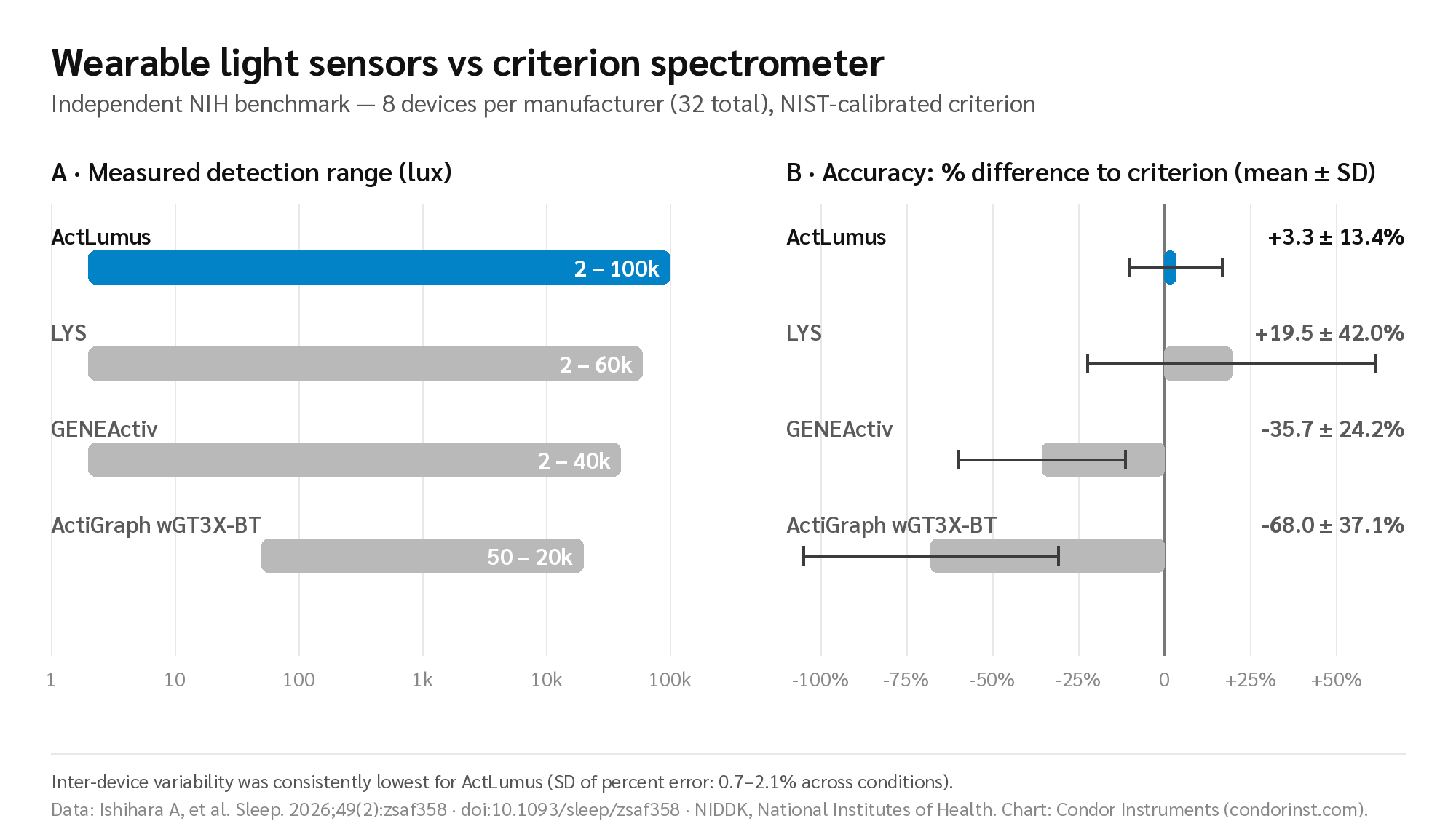
In the free-living arm of the same study, the least accurate sensor recorded a mean 24-hour illuminance of 77 lux against ActLumus’s 515 lux on the same wrists — a 6.7-fold disparity that the authors flag as a barrier to comparing light exposure across studies. Sensor choice, in other words, is not a detail: it determines whether your exposure estimates are usable.
What this looks like in a methods section
The practical test of any migration is whether your next paper survives review. A defensible transition paragraph looks like this:
“Legacy recordings (Philips Actiwatch Spectrum, 2019–2025) were converted to the analysis format using the ActStudio file converter (Condor Instruments). From 2026, participants wore the ActLumus actigraph; sleep parameters for both datasets were scored with the same algorithm implementation in ActStudio, removing scoring method as a source of between-device variation. Residual device differences were quantified in a parallel-wear subsample (n = X, 14 days). Light exposure from ActLumus is reported as photopic illuminance and melanopic EDI following CIE S 026:2018.”
Three details make this paragraph possible: the converter (one dataset, not two), the shared algorithm implementation (scoring method removed as a confound — note that identical scoring does not by itself make counts from different devices comparable, which is why the parallel-wear step exists), and the parallel-wear subsample that quantifies what remains. If you migrate to hardware without them, the honest version of this paragraph gets considerably harder to write.
Recommended migration protocol
- Inventory your Actiwatch archive. Convert legacy files with ActStudio and confirm epoch lengths and scoring settings reproduce your historical outputs.
- Run a parallel-wear period. Where feasible, have a subsample wear both devices for 7–14 days to quantify between-device offsets in your own population.
- Keep the Actiware algorithm as your bridge. Score old and new recordings with the same implementation while your protocols still reference it; adopt additional algorithms (Cole-Kripke, PIM) prospectively if desired.
- Treat melanopic EDI as a new primary variable. Photopic lux remains comparable across devices; melanopic EDI is a capability upgrade — pre-register how you will report it.
Where ActLumus stands in the peer-reviewed literature
- Ishihara, Brychta, LaMunion et al. (2026, Sleep) — the NIH benchmark described above: best measured accuracy (+3.3 ± 13.4%), widest detection range (2–100,000 lux) and lowest inter-device variability among the four wearable light sensors tested.[4]
- Murukesu et al. (2026, BMC Geriatrics) selected ActLumus for the LightSPAN randomised chronotherapeutic light-exposure trial in older adults.[5]
- Agbeshie et al. (2025, Open Research Europe) used ActLumus to measure physiologically relevant real-world light exposure in Kumasi, Ghana.[8]
Frequently asked questions
Can I still use my old Actiwatch data files?
Yes. ActStudio includes a converter between the Actiwatch data format and the Condor format, so legacy Actiwatch recordings can be opened and reprocessed alongside new ActLumus or ActTrust data.
Can I keep scoring sleep the way Actiware did?
Yes. ActStudio implements the sleep-scoring algorithm as described in the Philips Actiware documentation, and its output has been validated against Actiware scoring; Cole-Kripke, PIM, ZCM and TAT are also available. Labs migrating from the Actiwatch can keep a consistent scoring method across old and new recordings — and should confirm on a sample of their own historical recordings that outputs reproduce, as the migration protocol above recommends.
Can ActLumus data be exported in an Actiware-compatible format?
Yes — as CSV files in the same layout that Actiware exports. Analysis scripts, statistical pipelines and collaborations built around Actiware CSV output continue to work without modification. Note this is the CSV export layout, not the native .AWD file format.
Is ActLumus a direct replacement for the Actiwatch Spectrum?
It is the closest functional match — and in light measurement it exceeds the Spectrum: ten spectral channels versus three, a measured 2–100,000 lux detection range with +3.3 ± 13.4% accuracy in the independent NIH benchmark,[4] and melanopic EDI reporting per CIE S 026. Combined with legacy Actiwatch file conversion and Actiwatch-style scoring in maintained software, it is a migration path that preserves both your data archive and your scoring method without depending on discontinued tools.
How does ActLumus compare with GENEActiv for light measurement?
In the independent NIH benchmark, GENEActiv measured light across 2–40,000 lux with accuracy below −20% versus the criterion spectrometer; ActLumus measured across 2–100,000 lux at +3.3 ± 13.4%, with the lowest inter-device variability of the four sensors tested.[4] GENEActiv records one light channel (560 nm peak) and does not report melanopic EDI; ActLumus records ten spectral channels and derives melanopic EDI per CIE S 026.
How does ActLumus compare with the CamNtech MotionWatch 8 for light measurement?
Per CamNtech’s published specifications, the MotionWatch 8 records a single photopic light channel over 0–64,000 lux, with no published accuracy figure and no melanopic EDI; it was not included in the NIH benchmark.[7] ActLumus records ten spectral channels, measured 2–100,000 lux at +3.3 ± 13.4% accuracy in that benchmark,[4] and reports melanopic EDI per CIE S 026. If your protocol involves light exposure, that difference decides the choice.
Can I export raw data for R, Python or MATLAB?
Yes. Raw activity and spectral light-channel data can be exported for independent, reproducible analysis in any environment.
Planning a migration?
Tell us your study design and Actiwatch archive size. We will send the ActLumus technical sheet, the converter documentation, and a suggested protocol for bridging your legacy data.
References
- Activinsights Ltd. GENEActiv Instructions for Use, Rev. 010. Light sensor: peak 560 nm; range 0–50,000 lux (v1.3); accuracy ±30% @1,000 lux. Retrieved August 2026.
- Condor Instruments. ActLumus Manual v2.1.0 — 10-channel spectral architecture, photopic and melanopic outputs. condor.fabbricaweb.com.br (PDF).
- Philips Respironics. Legacy Actiwatch Spectrum documentation (discontinued line).
- Ishihara A, Brychta RJ, LaMunion SR, McGehee S, Donayre M, Jordan O, Davis K, Sanchez G, Smith L, Chung ST, Courville AB, Chen KY. Performance of wearable light sensors for measuring photopic and melanopic illuminance under laboratory and free-living conditions. Sleep. 2026;49(2):zsaf358. doi:10.1093/sleep/zsaf358. PMID 41230818. National Institute of Diabetes and Digestive and Kidney Diseases, NIH.
- Murukesu RR, Alkaff ZA, Del Villar D, et al. LightSPAN trial protocol. BMC Geriatrics. 2026. doi:10.1186/s12877-026-07105-6
- CIE. CIE S 026:2018 — System for metrology of optical radiation for ipRGC-influenced responses to light. Vienna: CIE, 2018.
- CamNtech Ltd. “MotionWatch 8” — light sensor (single channel, human-eye response, 0–64,000 lux) and battery specifications. camntech.com/motionwatch-8. Retrieved August 2026.
- Agbeshie GK, Osei Duah Junior I, Andoh AKA, et al. Physiologically relevant real-world light exposure and its behavioural and environmental determinants in Kumasi, Ghana. Open Research Europe. 2025;5:300. doi:10.12688/openreseurope.21304.1
Last reviewed August 2026 by the Condor Research Team. Actiwatch and Actiware are trademarks of Philips Respironics. GENEActiv is a trademark of Activinsights Ltd. MotionWatch is a trademark of CamNtech Ltd. ActiGraph is a trademark of ActiGraph LLC. Condor Instruments is not affiliated with, endorsed by, or sponsored by these companies. Comparative specifications are drawn from each manufacturer’s published documentation and from independent peer-reviewed benchmarks, as cited.