


Measurement journey · Wearable light and sleep research
For two weeks, mothers and fathers of infants aged 3–9 months wore actigraphs and light sensors and kept sleep diaries. The resulting portrait of wearable light and sleep in early parenthood shows nights that are long enough yet rarely unbroken, days spent mostly in dim light, and enormous variation from parent to parent and night to night.
Condor Instruments editorial team · · Summarizing a peer-reviewed article in npj Biological Timing and Sleep
The study in brief
In a paper published on 27 July 2026 in npj Biological Timing and Sleep (volume 3, article 37), Vaida Verhoef, Emma Visser, Karin Smolders, Niki Antypa, and Yvonne de Kort report descriptive findings from the SUNSHINE project: a two-week observational study of parents with infants aged 3–9 months that simultaneously tracked sleep and light exposure using wearable actigraphy, wearable light sensors, and daily sleep diaries. Nineteen parents (11 mothers and 8 fathers, including four couples) were recruited through online advertisements, Dutch university networks, and daycare flyers in the Eindhoven region; one parent was excluded because of very low protocol compliance (less than 10% of the expected data), leaving an analytical sample of 18. The authors are explicit about intent: this was not a hypothesis-testing experiment but a deliberate effort to characterize real-life patterns, quantify their variability across nights and individuals, and generate hypotheses for future work.
The headline observations: sleep duration was generally adequate in this sample, yet nights were frequently fragmented, with multiple awakenings and substantial variability across individuals and across nights. Light exposure during waking hours was predominantly dim, and brief exposures to light during sleep episodes were common. Season, infant sleep location, and caregiving roles appeared to shape these patterns — though, as the authors stress, descriptive findings do not establish causation.
The measurement question: why describe before explaining?
Postpartum sleep research has concentrated mainly on first-time mothers, the earliest weeks after birth, and short assessment windows. Fathers are rarely included, day-to-day analyses are uncommon, and light — the primary time cue of the circadian system — has seldom been measured at all in this population. The authors note that, to their knowledge, only four prior studies had monitored naturally occurring light exposure during the postpartum period, and most light-related research in new parents has tested interventions such as bright light therapy or blue-light-blocking glasses, with mixed or inconclusive results.
That gap creates a logical problem: without systematic descriptions of everyday light and sleep, it is unclear whether interventions address genuine deficits or even target the most relevant dimensions of exposure. The SUNSHINE team therefore asked a deliberately basic question — what do the sleep and light ecologies of mothers and fathers of 3–9-month-old infants actually look like, and how much do they vary?
Fourteen days of wearable light and sleep monitoring
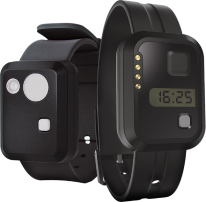
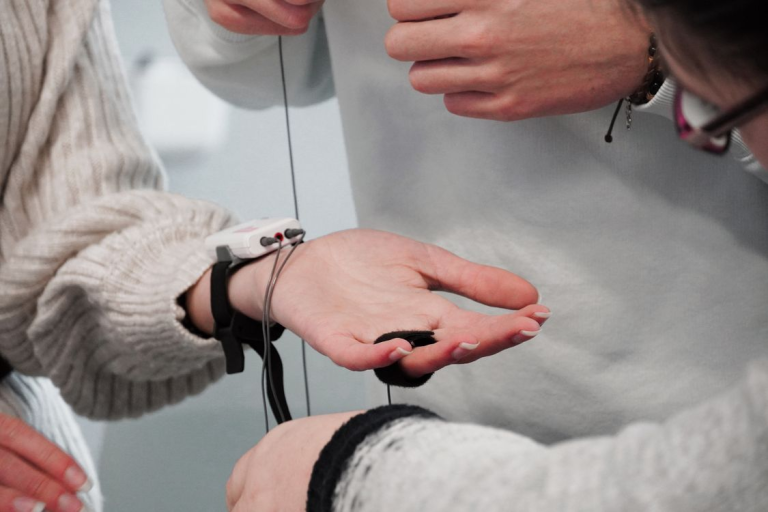
Parents were followed for 14 consecutive days, Monday through Sunday. Sleep was measured objectively with a wrist-worn actigraph (MotionWatch 8, CamNtech), recording tri-axial acceleration in 30-second epochs, and subjectively with the Consensus Sleep Diary–Morning version, delivered each morning at 07:00 via a mobile application. Daytime light exposure was measured with a personal light sensor (ActLumus, Condor Instruments) worn as a chest-level pendant during waking hours and placed on the nightstand, sensor facing upward, during sleep; the device sampled ten spectral channels once per minute, combined to derive photopic illuminance and melanopic equivalent daylight illuminance (EDI). Light during sleep episodes was additionally captured by the sensor integrated into the wrist actigraph. At intake, parents completed questionnaires including the Pittsburgh Sleep Quality Index (PSQI), the ultra-short Munich Chronotype Questionnaire, and the Edinburgh Postnatal Depression Scale (EPDS).
Of the 19 parents enrolled (11 mothers and 8 fathers), one was excluded for protocol compliance below 10%; the analyzed sample therefore comprised 18 parents — 12 mothers and 6 fathers — aged 28–37 years (mean 32.6). The source article reports mother/father counts that do not reconcile across the enrolled and analyzed samples; both published breakdowns are reproduced here without inferring which category changed after exclusion. Twelve parents were first-time parents and five had an older child (aged 2–6); eight worked full-time, five part-time, and three were on parental leave or not working. One parent did not provide demographic information and was included only in group-level analyses. Infants were aged 3–9 months at eligibility; ten slept in the parents’ room and six in their own room. These subgroup totals do not all equal 18 because some questionnaire fields were missing. Data collection spanned two seasons: summer (July–September), when the natural photoperiod ranged from 13.29 to 17.29 hours, and winter (November–December), when it shrank to 9.18–10.65 hours. The protocol was approved by the Ethical Review Board of the Human-Technology Interaction group at Eindhoven University of Technology (protocol 2095), and the work was funded by the LightCAP project (EU Horizon 2020, grant 860613) and the BioClock project (Dutch Research Council, 1292.19.077).
What the two weeks showed
The paper uses both denominators: 19 recruited parents for some descriptive/profile results, and 18 analyzed parents for analyses after the low-compliance exclusion; each result below retains the denominator reported by the authors.
Nights long enough, yet rarely unbroken
By actigraphy, the authors reported sleep onset at 21:02 ± 00:48 and wake time around 07:25 ± 00:37, alongside 9 h 09 m ± 1 h 09 m in bed, 8 h 29 m ± 1 h 00 m total sleep time, and 93.2% ± 5.9% sleep efficiency. These reported means should not be treated as a direct reconstruction of one another; the duration figures look reassuring until continuity is examined. Wake after sleep onset (WASO) averaged 40 ± 40 minutes, with 2.5 ± 1.3 awakenings per night, a longest continuous sleep bout of 5 h 48 m (±1 h 33 m), and a mean fragmentation index of 12.8% (±6.0%). Across all recorded nights, only 13.5% were free of nocturnal awakenings; nightly awakening counts ranged from zero to eight, with three most common. Awakenings clustered shortly after sleep onset (22:00–00:00) and again in the early morning (4:30–6:30). Most were brief — typically under ten minutes — but awakenings longer than 45 minutes occurred at least once for all but five parents, and some nights accumulated 150–200 minutes of WASO.
Diaries told a systematically different story: compared with actigraphy, parents reported sleep onset 48 minutes later (limits of agreement +14 to +83) and offset 30 minutes earlier (LOA −72 to +13), yielding roughly 78 minutes less time in bed. Retrospective PSQI scores ranged from 3 to 16 (mean 8.2 ± 3.2), with 15 of 17 respondents scoring 5 or higher — a range conventionally associated with poor sleep quality, though the authors present these as descriptive scores, not diagnoses. Most parents were morning types (12 of 19; 63%).
Two parents, two extremes
To make the heterogeneity tangible, the authors defined two purely illustrative profiles. A “Pristine Sleeper” (average WASO under 20 minutes, fewer than one awakening per night) described 3 of 19 parents; an “Extremely Fragmented Sleeper” (WASO over 60 minutes, more than three awakenings) described 4 of 19; the remaining 12 fell in between. The labels are explicitly not clinical classifications. The contrast is striking: the exemplar pristine sleeper (F-271) logged 7 h 18 m of sleep across 13 nights with only nine awakenings in total, about 10 minutes of WASO per night, 97.8% efficiency, and a 5.9% fragmentation index. The exemplar fragmented sleeper (F-201) averaged 3.38 awakenings and 1 h 31 m of WASO per night, a longest uninterrupted bout of just 4 h 24 m, 85.1% efficiency, and a 22.1% fragmentation index. The comparison is about continuity metrics, not a claim that their time in bed was comparable.
“Parental sleep might not be too short as much as disrupted,” the authors write — duration was generally adequate in this sample, while continuity was not.
What parents felt versus what sensors recorded
Nightly sleep-quality ratings spanned the full 7-point scale, with a cohort median of 4 (“neither good nor bad”); restedness had a median of 3 (“somewhat unrested”). Notably, three of the four extremely fragmented sleepers still rated their sleep quality around 5 — substantial objective fragmentation coexisted with moderately positive subjective evaluations. The retrospective PSQI aligned somewhat better with the objective profiles: two of the three pristine sleepers scored below 4, while all four extremely fragmented sleepers scored between 9 and 11.
Daytime rest: naps and quiet wakefulness
Diary-reported napping occurred on 19.4% of observation days (median naps per day: 0, range 0–2); when naps happened, they averaged 49.9 minutes (SD 54.6). Some parents reported no naps during the study period; the paper reports this as 20% of the cohort, without presenting the corresponding raw count in the prose. Actigraphy, by contrast, detected daytime rest periods on 99.2% of days — a median of six rest episodes per day (range 1–15) totaling a mean of 309 minutes (SD 180). The authors interpret this gap cautiously: actigraphic inactivity may blend genuine sleep, passive caregiving such as holding a sleeping infant, and quiet wakefulness, and actigraphy is known to overestimate sleep during sedentary periods.
Stable days, variable nights
Rest–activity rhythms looked relatively regular at the daily level — Interdaily Stability averaged 0.66 ± 0.09 (range 0.45–0.78), Intradaily Variability 0.38 ± 0.08 (0.27–0.54), and the Sleep Regularity Index 72.5 ± 4.1% (62.5–81.3%). But intraclass correlations showed that most variance in total sleep time (ICC = 0.27) and WASO (ICC = 0.12) came from fluctuations within the same parent across nights, not from stable differences between parents. By day 9, the two exemplar trajectories showed similar fragmentation patterns, although their overall profiles remained different; fragmented sleepers occasionally enjoyed consolidated nights, and pristine sleepers were not spared disruption.
Dim days, mostly dark nights — with exceptions
On average, parents spent 77.65% of waking hours below 250 photopic lux. The paper states that its time-above-threshold measures above 100, 250, 1,000 and 10,000 lux were computed on photopic illuminance, while melanopic EDI was reported separately. Between-person differences in daytime exposure were large and stable (ICCs of 0.69 for photopic illuminance and 0.72 for melanopic EDI, with time-above-threshold ICCs from 0.41 to 0.64). Two parents (F-291, F-331) experienced consistently dimmer days, with no time above 1,000 or 10,000 photopic lux. During sleep episodes, photopic illuminance ranged from 0 to 582 lux, though nightly averages stayed low (1.05–1.82 lux). Still, every parent experienced photopic exposures above 10 lux during sleep; 17 of 18 exceeded 50 lux and 15 of 18 exceeded 100 lux, for varying durations. Day-to-day light patterns were irregular: Interdaily Stability of light exposure was always below 0.33, with high Intradaily Variability (0.97–1.85). Eleven parents showed recognizably “stable” light days alongside more “dynamic” ones, and recurring patterns hinted at links with work and work-free days.
Seasons, infants, and the division of care
Season left visible traces. Parents monitored in winter spent less than 20% of waking hours above 250 photopic lux, versus about 35% in summer; the mean timing of exposures above 250 and 1,000 photopic lux fell between 14:00 and 15:00 in summer but shifted earlier in winter (12:30–14:10 and 10:25–11:35, respectively). After dusk, summer light exposure was typically low (rarely above 10 photopic lux), while winter evenings brought artificial light up to about 100 photopic lux, at times blurring the day–night boundary.
Infant and caregiving factors showed modest, descriptive associations. Room-sharing parents tended to spend somewhat more time awake at night despite similar total sleep; parents of younger infants (under 6 months) slept longer but with more frequent and prolonged awakenings; breastfeeding parents slept slightly longer but with more WASO. Time above 10 lux during sleep was on average slightly longer when the baby slept in a separate room — consistent with getting up to provide care — yet individual cases defied the averages: two room-sharing parents spent under 3% of sleep time above 10 lux, M-321 reached about 10.0%, and the parent whose baby slept in the parental bed — F-201, a room-sharing arrangement — reached 10.73%.
Gender differences appeared mainly in continuity and light. Mothers showed more WASO and a median of three awakenings per night versus two in fathers, with nearly identical bed- and wake-times and comparable total sleep — yet mothers and fathers recalled similar numbers and durations of awakenings in their diaries, and fathers tended to overestimate WASO relative to actigraphy. Mothers’ naps were generally longer; fathers spent more waking time above 100, 250, and 1,000 lux, while above 10,000 lux the groups looked alike. Within couples, shared routines synchronized some patterns (recurring light dips at the same hours) while diverging sharply in others: in couple 4, the mother experienced light above 10 lux every night while the father’s nights were mostly dark; couple 2 showed the opposite tendency.
Reading the findings in context
The authors place their observations against consensus recommendations in the literature (Brown et al., 2022): daytime light above 250 melanopic EDI lux at eye level, evening light below 10, and sleep-period light below 1. The study’s time-above-threshold results were computed on photopic illuminance, while melanopic EDI was reported separately; therefore they cannot be directly equated with those melanopic EDI recommendations. The parents’ waking hours were predominantly dim in the study’s photopic measures, and their sleep episodes were frequently punctuated by brief photopic exposures above 10 lux — a comparison that should not be interpreted as a direct test of the melanopic EDI guidance. The wake-time results echo earlier small studies of postpartum mothers (Tsai et al. reported 71.13% of the day below 50 lux; another small study reported a 73-lux waking average), while nighttime exposure appeared marginally brighter in this sample. The authors frame the sleep pattern as “negotiated sleep”: parents appear to compensate for expected interruptions by extending time in bed, a behavioral adaptation to infant care rather than physiology alone.
Interpretive caution is warranted throughout. Prior literature associates sleep fragmentation and night-to-night variability with depressive symptoms, fatigue, and reduced caregiving sensitivity; the authors reported EPDS scores as part of the broader questionnaire context, but this descriptive study did not test whether mood scores were related to the measured sleep–light patterns, and its design cannot support causal claims. The authors also highlight a measurement lesson: scalar metrics such as time-above-threshold cannot distinguish a continuous morning block of bright light from irregular late-day bursts, even though their circadian implications may differ; newer regularity metrics remain unvalidated, and no current metric captures intensity, duration, and timing together.
Limitations
The sample was modest (18 analyzed parents) and relatively homogeneous socioeconomically and culturally, limiting generalizability, and its size precluded formal control of confounders such as work schedules, caregiving arrangements, or environment. Two weeks offer only a snapshot of the postpartum period. Chest- and wrist-worn sensors estimate light at the worn location rather than at the eye and may mischaracterize exposure through occlusion or placement; actigraphy infers sleep from movement and can misclassify quiet wakefulness, caregiving immobility, or co-sleeping, with algorithmic choices directly affecting classifications. Only four couples were included, so dyadic patterns are hints, not findings. The results are an ecological portrait — not estimates of association or mechanism.
Conclusion: measurement first
The SUNSHINE project’s contribution is fundamentally about measurement and context. By pairing wearable light and sleep sensing over two ordinary weeks, it shows that early parenthood is not one sleep pattern but many — variable across nights, divergent between partners, and embedded in seasons, rooms, feeding arrangements, and household routines. That heterogeneity is exactly what averages conceal, and it is what future circadian-aware studies and any eventual interventions must be designed around. Description, in this field, is not a preliminary courtesy; it is the empirical foundation.
Nothing in this article constitutes medical advice. Families with concerns about sleep or mood should consult a qualified health professional.
References
- Verhoef, V., Visser, E., Smolders, K., Antypa, N., & de Kort, Y. (2026). Sleep and light ecologies of parents with young infants: descriptive findings from the SUNSHINE project. npj Biological Timing and Sleep, 3, 37. DOI: 10.1038/s44323-026-00098-w · PMID: 42509485 · Publisher: Springer Nature (nature.com)
- Brown, T. M., et al. (2022). Recommendations for daytime, evening, and nighttime indoor light exposure to best support physiology, sleep, and wakefulness in healthy adults. PLoS Biology, 20, e3001571. (Cited within the study.)
- Tsai, S.-Y., Barnard, K. E., Lentz, M. J., & Thomas, K. A. (2009). Twenty-four hours light exposure experiences in postpartum women and their 2–10-week-old infants: an intensive within-subject design pilot study. International Journal of Nursing Studies, 46, 181–188. (Cited within the study.)
- Kalogeropoulos, C., et al. (2022). Sleep patterns and intraindividual sleep variability in mothers and fathers at 6 months postpartum: a population-based, cross-sectional study. BMJ Open, 12, e060558. (Cited within the study.)
- Ohayon, M. M., Carskadon, M. A., Guilleminault, C., & Vitiello, M. V. (2004). Meta-analysis of quantitative sleep parameters from childhood to old age in healthy individuals. Sleep, 27, 1255–1273. (Cited within the study.)
- Watson, N. F., et al. (2015). Recommended amount of sleep for a healthy adult: a joint consensus statement of the American Academy of Sleep Medicine and Sleep Research Society. Journal of Clinical Sleep Medicine, 11, 591–592. (Cited within the study.)